Five APPs named finalists for 2026 March of Dimes Heroes in Action Awards
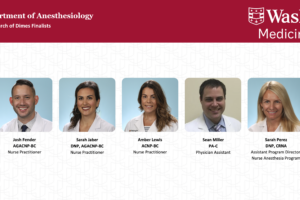
The Department of Anesthesiology is proud to recognize five of its Advanced Practice Providers (APPs) who have been named finalists for the March of Dimes Heroes in Action 2026 awards.
Trish Wilkinson appointed Director of Critical Care APPs

Trish Wilkinson, MSN, ACNP-BC, has been appointed Director of Critical Care APPs. A 14-year division veteran, she will oversee nearly 100 APPs across academic, community, and tele-critical care settings.
Four anesthesiology faculty recognized by the Academy of Educators

WashU Medicine Department of Anesthesiology faculty members were recognized at the Academy of Educators Education Day in October 2026, recognizing their contributions to education and their commitment to developing the next generation of healthcare professionals.
Al-Hasani elected president-elect of international neuroscience society (Links to an external site)

Ream Al-Hasani, PhD, associate professor of anesthesiology at WashU Medicine, has been elected president-elect of the International Society for Monitoring Molecules in Neuroscience (MMiN).
Bridging the gap: How philanthropy accelerated the search for safer pain relief
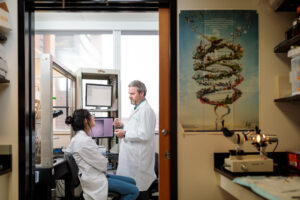
Support from the Dr. Seymour & Rose T. Brown Professorship helped Dr. Rob Gereau turn an early research idea into a promising path toward safer, more effective treatments for chronic pain.
Study reveals how ketamine interacts with opioid receptors (Links to an external site)

WashU Medicine researchers have uncovered new insights into the pharmacology of ketamine that help explain both its rapid benefits and its risks.
Mental health care before, after surgery improves recovery in older adults (Links to an external site)

Clinical trial supports adding mental health coaching, medication cleanup to routine pre-surgical care.
McCall, Al-Hasani, and Moron-Concepcion to study how fentanyl disrupts the brain’s locus coeruleus system

Jordan McCall, Ream Al-Hasani, and Jose Moron-Concepcion, faculty in the Department of Anesthesiology at WashU Medicine, have received a five-year, $3,414,110 grant from NIDA to investigate how fentanyl use disrupts the brain’s noradrenergic locus coeruleus system and drives relapse.