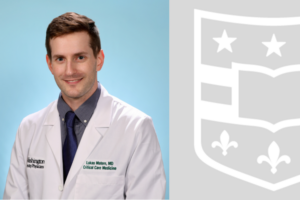
Erin Herrera, CRNA, has been named Co-Director of CRNA Activities for the Department of Anesthesiology at WashU Medicine.
Herrera named Co-Director of CRNA Activities
Department of
Erin Herrera, CRNA, has been named Co-Director of CRNA Activities for the Department of Anesthesiology at WashU Medicine.
Rachel Moquin, EdD, has been appointed as Vice Chair for Academic Affairs and Professional Development in the Department of Anesthesiology at WashU Medicine.
The Department of Anesthesiology is proud to announce that six of its Advanced Practice Providers (APPs) have been named finalists for the March of Dimes Heroes in Action 2025 awards.
Anne Drewry, MD, MS, Vice Chair and Division Chief of Critical Care Medicine, has been appointed the inaugural Llorin-Roa Professor of Anesthesiology.
At this year’s Education Day, Dr. Allison Mitchell was inducted as a new member of the Academy and Dr. Rachel Moquin received the Rising Star Award.
The Department of Anesthesiology is proud to recognize team members who have received accolades through the SAFE (Supporting a Fair Environment) Reporting platform.
Scientists, clinicians, and trainees gathered at the University of Health Sciences and Pharmacy in St. Louis (UHSP) this past September for the second St. Louis Translational Pain Research Forum (STL-TPRF), an event designed to foster collaboration and mentorship within the region’s growing pain research community.
With funding from the National Institutes of Health (NIH), ShiNung Ching and Ben Palanca seek to develop personalized medicine strategies for treatment-resistant depression that would tailor drug dosage based on a patient’s age, genetics, health conditions, brain dynamics and neural circuits.
Megan Moseley, PA-C, has been selected as one of only three people nationwide to receive the 2025–26 AAPA-PAEA Research Fellowship. She is the first physician assistant (PA) from WashU Medicine to earn this honor since the fellowship’s inception.
A multidisciplinary team of researchers at WashU Medicine plans to investigate the neural mechanisms behind various controls of transcutaneous spinal cord stimulation in generating different leg movements with a five-year, nearly $3 million grant the National Institutes of Health (NIH).