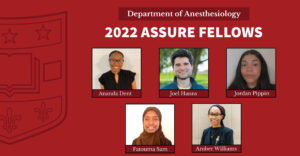
The Department of Anesthesiology announces the 2022 cohort of ASSURE Fellows.
Announcing the 2022 Cohort of ASSURE Fellows (Links to an external site)
Department of
The Department of Anesthesiology announces the 2022 cohort of ASSURE Fellows.

Zhou-Feng Chen, PhD, director of the Center for the Study of Itch & Sensory Disorders at Washington University School of Medicine in St. Louis, alongside his team, identified a neural circuit and a neuropeptide in mice — a chemical messenger that carries signals between nerve cells — that transmit the sensation known as pleasant touch from the skin to the brain.
An implanted device that will automatically detect an overdose and give the opioid blocker naloxone is under development by Robert Gereau, Ph.D., of Washington University in St. Louis, Missouri, and John Rogers, Ph.D., of Northwestern University in Evanston, Illinois.
Senior investigator Simon Haroutounian, PhD, chief of clinical research at the Washington University Pain Center alongside other researchers at Washington University School of Medicine have found that many people who tested positive for the coronavirus in the early months of the pandemic also experienced peripheral neuropathy during and following their bouts with COVID-19.
The Department of Anesthesiology at Washington University School of Medicine in St. Louis ranked #2 nationwide among anesthesiology departments in funding from the National Institutes of Health (NIH).
Global researchers created a wireless network utilizing implantable devices and equipment integrated with IoT technology, enabling neuroscience experiments that can virtually study the brains of animals.
Led by Jose Moron-Concepcion, PhD, the findings (published online Oct. 18 in the journal Nature Neuroscience) could lead to treatments targeting the emotion-related aspects of pain.
The National Institute of Mental Health (NIMH) has awarded Washington University School of Medicine in St. Louis a five-year, $12.2 million grant to create a center aimed at advancing research into neurosteroids as treatments for depression and other psychiatric disorders.
In a recent study published in Nature Neuroscience, Dr. Ream Al-Hasani and colleagues have identified a new role for a GABA projection in reward processing which could lead to new treatments for addiction and depression.
Clinicians and researchers at Washington University School of Medicine in St. Louis have received a four-year, $6.2 million grant from the National Institute of Mental Health to launch a center designed to help improve mental health in surgery patients, particularly older surgery patients. The center will conduct studies to identify and treat depression and anxiety in surgical patients. This new center is the first NIH-funded center of its kind in the United States.