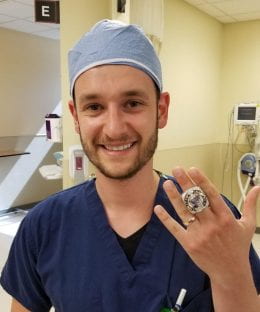
Undergraduate: WashU, 2011, BS Biomedical Engineering
Medical School: WashU Medicine, 2015.
Residency: WashU Medicine, 2019
Fellowship in Regional and Ambulatory Anesthesia: WashU Medicine, 2020
What have you done since residency?
After residency I stayed at WashU to complete a fellowship in regional and ambulatory anesthesia. Our one-year fellowship here gives you over 1,000 ultrasound-guided nerve blocks and a deep experience in acute pain management. After fellowship I was excited to join the faculty at WashU as a regional and general anesthesiologist. Though I never saw myself as an academic anesthesiologist, I found myself enjoying teaching, being able to do a lot of sub-specialty work (regional in my case), and being in a large department with lots of support. Academic medicine includes more than just the research aspect that so many think about, and has a lot of attractive aspects for a recent graduate.
How did WashU’s residency program prepare you for your practice?
In my case, the transition to practice was quite smooth given my 5 years in the department already. That being said, WashU’s residency was broad, challenging, and nurturing, and I believe it would have set me up for success at most hospitals. It is always easier to scale back on needed skills than to learn new ones on the job. Barnes Jewish and Children’s Hospitals, where you would train as a resident at WashU, attract some of the most complex and varied pathologies, patients, and cases. You will be able to carry forward what you learned here into your practice and not be too scared of difficult patients.
What advice would you give to applicants?
First, I would say pick a residency that gives you a very broad experience. Many big city hospitals suffer from having a high volume in certain fields and shortage in others. This is not ideal for training a resident who needs a great experience in all the fields. It’s a good sign if a program offers most of the anesthesia fellowships. Programs also like to keep their own residents for fellowship so this gives you options later on!
Second, pick a residency where you feel supported both at work and at home. Residency can be tough, so set yourself up for happiness. Cost of living, commute times to all residency rotations, safety around the medical campus, camaraderie of the residents, a non-hostile work and learning environment, and support from the department for other academic pursuits are all valid and important concerns. You should explore these factors at each program. I assure you WashU checks all of these boxes.