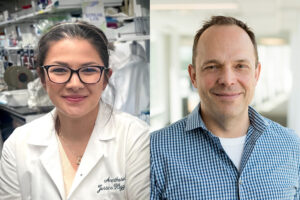
Padma Gulur, MD, nationally renowned pain specialist, will lead the Department of Anesthesiology at WashU Medicine beginning Aug. 1.
Gulur named head of anesthesiology (Links to an external site)
Department of
Padma Gulur, MD, nationally renowned pain specialist, will lead the Department of Anesthesiology at WashU Medicine beginning Aug. 1.
WashU Medicine researchers, including Dr. Jordan McCall from the Department of Anesthesiology, have shown that certain psychedelic compounds break the link between neurological functions and blood flow in the brain.
WashU Medicine researchers recognized for significant contributions to data science.
Meaghan Creed, an associate professor of anesthesiology at WashU Medicine, has received a $3.3 million five-year grant from the National Institute on Drug Abuse to study dopamine system changes underlying depression symptoms in people with chronic neuropathic pain.
Simon Haroutounian, PhD, MSc, has been appointed to the Russell D. and Mary B. Shelden Professorship in Anesthesiology.
Amynah Pradhan, PhD, has been appointed to the Russell D. and Mary B. Shelden Professorships in Anesthesiology at WashU Medicine.
Scientists, clinicians, and trainees gathered at the University of Health Sciences and Pharmacy in St. Louis (UHSP) this past September for the second St. Louis Translational Pain Research Forum (STL-TPRF), an event designed to foster collaboration and mentorship within the region’s growing pain research community.
With funding from the National Institutes of Health (NIH), ShiNung Ching and Ben Palanca seek to develop personalized medicine strategies for treatment-resistant depression that would tailor drug dosage based on a patient’s age, genetics, health conditions, brain dynamics and neural circuits.
Megan Moseley, PA-C, has been selected as one of only three people nationwide to receive the 2025–26 AAPA-PAEA Research Fellowship. She is the first physician assistant (PA) from WashU Medicine to earn this honor since the fellowship’s inception.
A multidisciplinary team of researchers at WashU Medicine plans to investigate the neural mechanisms behind various controls of transcutaneous spinal cord stimulation in generating different leg movements with a five-year, nearly $3 million grant the National Institutes of Health (NIH).