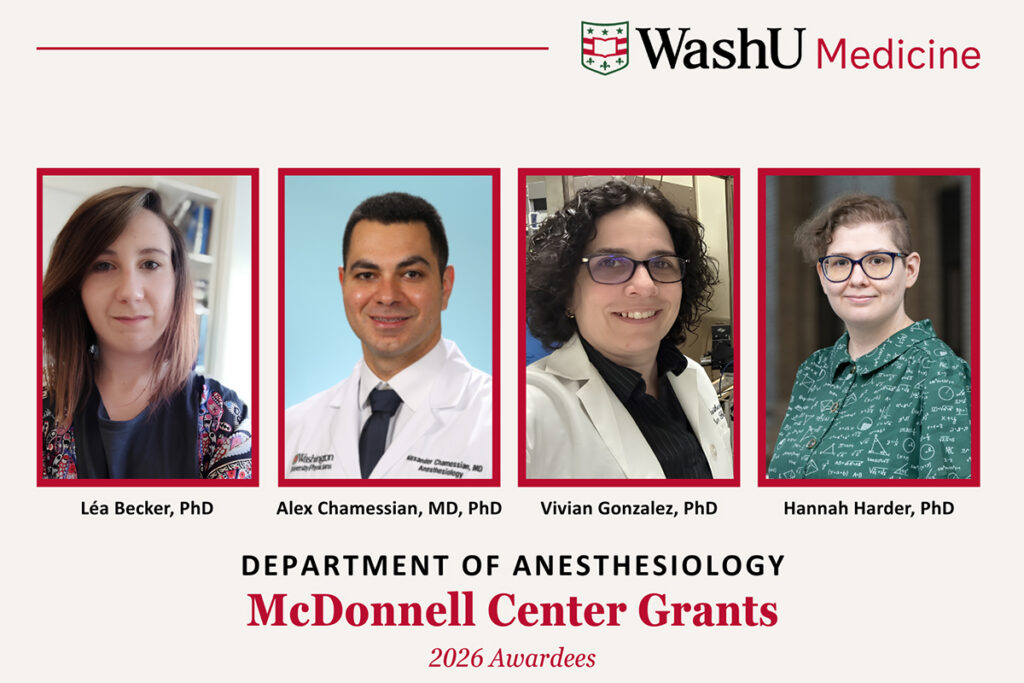
Four researchers from the Department of Anesthesiology at WashU Medicine have been selected as recipients of this year’s McDonnell Center Grants, awards designed to promote innovative pilot projects, collaborative research, and early-stage ideas that are not yet supported by traditional funding mechanisms.
The McDonnell Center for Systems Neuroscience has recognized two of the department’s postdoctoral fellows for their promising work exploring the neural frameworks of substance use disorders. Léa Becker, PhD, and Hannah Harder, PhD, will both receive up to $50,000 per year for one to two years, with funding beginning July 1, 2026.
Becker, a postdoctoral fellow in the McCall Lab, is investigating how opioid withdrawal alters communication between neuromodulatory and glial systems in the brain. Her project, “Determining the role of norepinephrine–oligodendrocyte signaling in fentanyl withdrawal-induced negative affect,” focuses on how disruptions in norepinephrine signaling to oligodendrocytes — the brain’s myelin-producing cells — may impair myelination and contribute to the negative emotional states that drive relapse in opioid use disorder. By defining this interaction between neurotransmitters and glial cells, Becker aims to identify new biological targets for treating addiction-related affective symptoms.
Harder, a postdoctoral fellow in the Morón-Concepción Lab, is studying how early-life exposures shape long-term vulnerability to addiction. Her project, “Long-term effects of maternal pain and prenatal opioid exposure on future drug-seeking,” examines how the combination of maternal pain and prenatal opioid exposure impacts neurodevelopment and later drug-seeking behavior. Her work suggests that this combined exposure leads to increased opioid-seeking in adulthood, with a pronounced effect in males. She aims to identify the neural circuits responsible for this heightened vulnerability to better understand how early developmental conditions influence addiction risk.
For the McDonnell Center for Cellular and Molecular Neurobiology Small Grants Award, assistant professor of anesthesiology Vivian Gonzalez-Perez, PhD, is focused on improving the specificity and safety of pain therapeutics. Her project, “Regulatory subunits of BK potassium channels: a strategy for developing analgesia minimizing off-target effects,” looks at regulatory proteins associated with certain potassium channels in cells that help control pain signals. By targeting these smaller, more specific components instead of affecting the whole system, her goal is to target specific cell types for ameliorating pain while reducing side effects and lowering the risk of addiction. The overall aim is to develop more targeted, non-addictive treatments for chronic pain. Gonzalez-Perez will also receive up to $50,000 per year for one to two years, with funding beginning July 1, 2026.
In addition to the Small Grants awards, assistant professor of anesthesiology Alex Chamessian, PhD, received support through the McDonnell Center’s New Resource Proposal mechanism, which provides funding for developing shared research tools and infrastructure. His proposal was awarded $40,000 to support the purchase of a human microneurography system, a specialized technology that enables direct recording of peripheral nerve activity in humans.
Together, these awards highlight the McDonnell Centers’ commitment to supporting innovative, collaborative research. Through these projects, investigators are advancing new approaches to understanding and treating addiction, pain, and neurodevelopmental vulnerability.