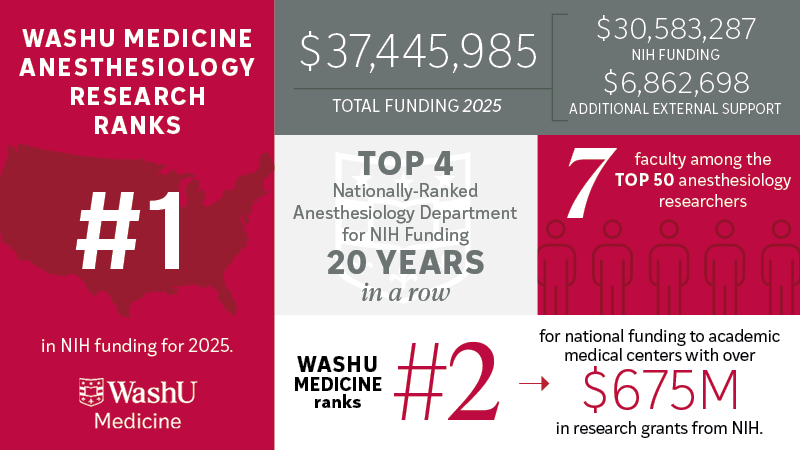
The Department of Anesthesiology at WashU Medicine has been ranked No. 1 in the nation in National Institutes of Health (NIH) funding among anesthesiology departments, according to the 2025 Blue Ridge Institute for Medical Research (BRIMR) rankings.
BRIMR compiles annual NIH funding data from more than 50 anesthesiology departments across the United States, and its rankings are widely regarded as a benchmark of academic research strength and national impact. WashU Medicine Anesthesiology has ranked among the top five nationally for 20 consecutive years since the inception of the BRIMR anesthesiology rankings in 2006.
This marks the second consecutive year the department has achieved the No. 1 position and the fourth time overall, with previous top rankings in 2008, 2014, and 2024.
In fiscal year 2025, the department secured $30,583,287 in NIH funding, along with an additional $6,862,698 in non-NIH external support, for a total research portfolio exceeding $37.4 million.
The department’s 164 funded projects include 88 R-series grants, 14 U-series grants, and 8 K-series career development awards. In addition to NIH support, faculty received grants from a broad range of foundations and institutes, including the American Academy of Physician Associates, American Headache Society, Association of Migraine Disorders, Barnes-Jewish Hospital Foundation, Foundation for Anesthesia Education and Research, Howard Hughes Medical Institute, Patient-Centered Outcomes Research Institute, and the PhRMA Foundation.
“We are delighted to be the number one NIH-funded anesthesiology department two years running,” said Michael S. Avidan, MBBCh, FCA SA, Head of the Department of Anesthesiology.
“This impressive accomplishment reflects the impact of our scientists across the translational continuum — we are making foundational discoveries, advancing knowledge, and changing people’s lives.”
Michael S. Avidan, MBBCh, FCA SA, Head of the Department of Anesthesiology
Several department faculty ranked among the Top 50 NIH-funded anesthesiology investigators this past year, including:
Susruta Majumdar, PhD
Professor of Anesthesiology
The Majumdar Lab studies how to make opioids work in a way that relieves pain without causing serious side effects. They combine chemistry, biology, and genetics to create and test new drugs.
Dr. Majumdar currently leads an R01 grant focused on designing new opioids that target specific pathways in the body, so they can provide strong pain relief while lowering the risk of addiction, breathing problems, and other harmful effects.
Robert Gereau, PhD
Vice Chair for Research; Dr. Seymour & Rose T. Brown Professor of Anesthesiology; Division Chief for the WashU Medicine Pain Center
The Gereau Lab focuses reducing pain and improving patient quality of life.
Dr. Gereau is the Principal Investigator on a HEAL Initiative grant, known as the INTERCEPT Pain program, which supports groundbreaking research into the genetics and neurobiology of pain.
Burel Goodin
Professor of Anesthesiology
The goal of the Goodin Lab, also known as the Translational Research to Advance Pain Science (TRAPS) Lab, is to increase awareness of the influence of social factors on pain physiology, perception, and treatment responses.
Currently, Dr. Goodin is working on the HIP HOP study, which focuses on people with HIV and their experiences with insomnia and chronic pain – both of which are linked to worse quality of life and faster biological aging. The HIP HOP study tests whether a four-week, telephone-based insomnia treatment can improve sleep, reduce pain, enhance quality of life, and slow biological aging, while also examining how social and environmental factors influence treatment response.
Meaghan Creed, PhD
Associate Professor of Anesthesiology
The Creed Lab studies how brain circuits in the ventral basal ganglia control learning, decision-making, and flexible behavior. They focus on how connections between neurons change and how brain signals are regulated in these circuits.
Dr. Creed leads several major research projects, including one with Assistant Professor Vijay Samineni, PhD. This project looks at why some people continue using opioids even when facing negative consequences and aims to find ways to prevent or reverse this behavior in opioid use disorder.
Jose Moron-Concepcion, PhD
Henry E. Mallinckrodt Professor of Anesthesiology; Division Chief, Division of Basic Research
The Moron-Concepcion Lab studies how opioids affect the brain and behavior, including how persistent pain changes the way opioids feel rewarding or motivating. Their team is currently exploring safer ways to reverse opioid overdoses, especially from fentanyl. Their research focuses on the nerves and brain circuits that control breathing, testing new treatments that could stop overdoses without causing withdrawal or other unpleasant side effects.
Vijay Samineni, PhD
Assistant Professor of Anesthesiology
The Samineni Lab focuses on understanding the neural mechanisms that regulate the function of visceral organs—such as the stomach, intestines, and other internal organs—and their connections to the brain.
In addition to his project with Dr. Creed, Dr. Samineni leads three R01 grants, all of which focus on understanding the neural mechanisms underlying interstitial cystitis/bladder pain syndromes (IC/BPS). Specifically, these projects aim to identify and characterize the neuronal circuits and cell populations involved in bladder function and nociception, with the goal of better understand the pathology of IC/BPS and developing new therapeutic strategies.
Hadas Nahman-Averbuch, PhD
Assistant Professor of Anesthesiology
The Nahman-Averbach Lab, also known as the Pain Across the Lifespan (PAL) Lab, studies how people of all ages—kids, teens, and adults—feel and process pain. Her team aims to understand why some people are more sensitive to pain than others and why some develop chronic pain.
Currently, Dr. Nahman-Averbuch leads several major research projects looking at how migraines start in teenagers and how they may progress over time.
“This recognition reflects the outstanding research happening in the Department of Anesthesiology at WashU Medicine,” said Robert Gereau, PhD, the Dr. Seymour and Rose T. Brown Professor of Anesthesiology and Vice Chair for Research.
“Our faculty are advancing the frontiers of science, from fundamental work on ion channel and receptor structure and function that informs drug discovery efforts, to exploring the biology of chronic pain to developing innovative therapies for patients undergoing complex surgical care,” Gereau continued.
“NIH support enables us to translate discovery into meaningful improvements in patient outcomes and to continue shaping the future of anesthesiology.”
In addition to the department’s distinction, WashU Medicine ranked No. 2 nationally overall, securing more than $675 million in NIH research funding.
Learn more about research in the Department of Anesthesiology.