Researchers at WashU Medicine have uncovered how the delta opioid receptor, a promising target for treating chronic pain, anxiety, and depression, can be controlled to improve therapeutic effects. Sarah M. Bernhard, PhD, a graduate student in the WashU Medicine Neuroscience Program, and Susovan Roy Chowdhury, PhD, a postdoctoral fellow in anesthesiology, co-led the study, which explains how different drugs interact with this receptor and why some compounds are more effective than others. The study, published in Science Advances on March 25, 2026, could guide the development of safer, non-addictive opioid-based therapies.
Using advanced techniques including structural biology, pharmacology, and single-molecule fluorescence, the team showed that the delta opioid receptor is not a simple on/off switch. Instead, it moves between multiple states, and different drugs shift it into specific states that change how it signals. The researchers also discovered that some drugs previously thought to block the receptor can actually increase its availability at the cell surface, suggesting new ways to make treatments more effective.
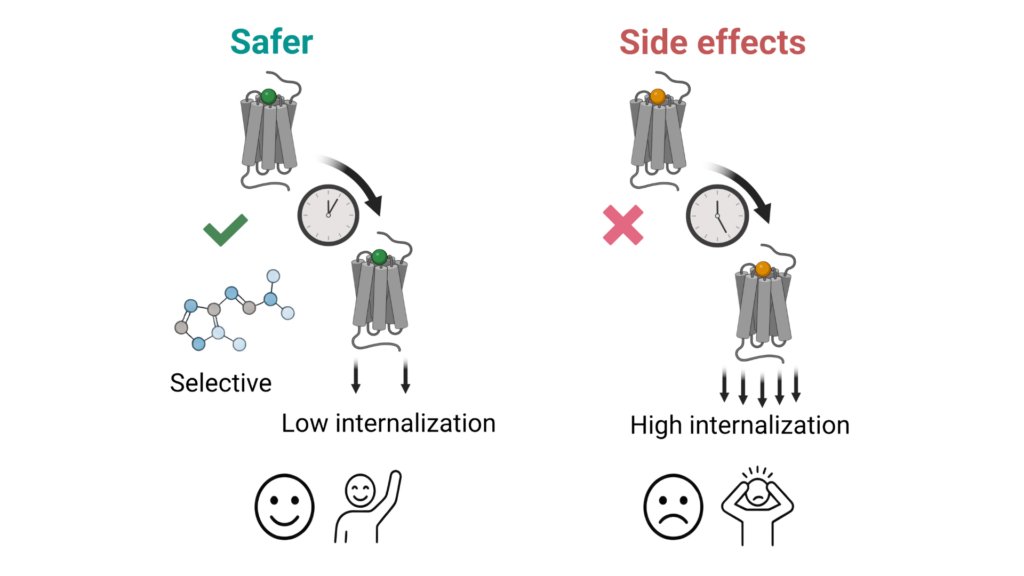
Created in BioRender. CHE, T. (2026) https://BioRender.com/hxmgrqa
The study was supervised by Associate Professor in the Department of Anesthesiology, Tao Che, PhD, and Professor of Anesthesiology, Baron Chanda, PhD. It was also supported by the Alan A. and Edith L. Wolff Professor of Medicine, Sarah England, PhD; Professor of Anesthesiology, Susruta Majumdar, PhD; and Assistant Professor of Biochemistry and Molecular Biology at the University of Maryland School of Medicine, Jon Fay, PhD. Bernhard is co-mentored by Che and Majumdar, while Chowdhury is mentored by Chanda.
“By combining structural biology with single-molecule experiments, we were able to see not just how drugs bind the delta opioid receptor, but how they change its function,” said Che.
These insights provide a roadmap for designing next-generation therapeutics that offer effective pain relief with fewer side effects, and may also be relevant for treating depression and anxiety.