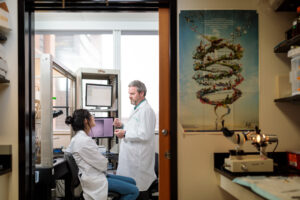
For people living with chronic pain, effective treatment can come with difficult tradeoffs. Some medications cause significant side effects, while others carry the risk of dependence or addiction. Rob Gereau, PhD, vice chair for research in the Department of Anesthesiology, has spent years looking for a better approach — one that could provide effective pain relief without the risks associated with many existing therapies.
Gereau had long been interested in the potential of plant-inspired compounds, including cannabinoids, to treat pain without affecting the brain. To pursue the idea on a larger scale, however, he needed preliminary data to demonstrate that it could work. That vital early support came from the Dr. Seymour & Rose T. Brown Professorship in Anesthesiology. Established by the Brown family to support pioneering research in the department and awarded to Gereau in 2014, the endowed professorship gave him the resources needed to take that crucial first step.
Building the Foundation
That early investment quickly helped turn an idea into a research program. Gereau recruited postdoctoral researcher Richard Slivicki, PhD, who generated the preliminary data needed to secure a major National Institutes of Health grant to investigate peripheral cannabinoid receptors as a target for pain management. Slivicki also led a study published in PAIN demonstrating that cannabinoids could reduce pain signaling in the body without producing effects in the brain.
Engineering Safer Alternatives
The findings opened the door to the next phase of the research. The Gereau Lab partnered with Susruta Majumdar, PhD, a professor of anesthesiology at WashU Medicine’s Center for Clinical Pharmacology, to design new drug molecules specifically engineered to act outside the brain. The goal was to develop compounds that could provide powerful pain relief while avoiding the lightheadedness, altered mental state and potential for dependence associated with drugs that act on the central nervous system.
When the compounds showed promise in animal studies, the team continued to refine and test them, moving from a proof of concept toward potential therapies.
Today, what began as an early research idea has grown into a drug discovery pipeline. The team has developed two promising drug candidates, filed patents for novel compounds and is preparing additional findings for publication as the researchers work toward eventual clinical trials in humans.
From Concept to Pipeline
The work is still underway, but the path forward is clear: determine whether these discoveries can ultimately be translated into new treatments for the estimated 50 million people in the United States living with chronic pain.
For Gereau, the progress represents more than a series of research milestones. It is an example of what can happen when researchers have the support to pursue an idea before they know where it will lead.
“None of this would have been possible without the generosity of the Brown family. Their support gave us the opportunity to pursue an idea, generate the data and build the foundation for the work we are doing today.”
Rob Gereau, PhD, Vice Chair for Research; Division Chief, WashU Medicine Pain Center
Fuel the Next Discovery
Early-stage donor support gives researchers the freedom to pursue innovative ideas before traditional grant funding is available. Whether you are interested in supporting pilot research, funding a postdoctoral fellowship, or endowing a professorship, your gift accelerates breakthroughs in patient care.
- Explore Endowed & Leadership Gifts — Learn how targeted gifts can create lasting opportunities.
- Support Our Department’s Mission — Help provide seed funding for high-potential research and advance patient care across the department.