Max Kelz, MD, PhD, highlighted groundbreaking research on the science of consciousness; more than 70 posters featured in annual Academic Showcase.
On May 26, 2026, the Department of Anesthesiology at WashU Medicine welcomed faculty, staff, and guests to the 38th Annual C.R. Stephen Lecture, held at the Eric P. Newman Education Center. The longstanding lecture series pays tribute to C. Ronald Stephen, MD, FFARCS, the department’s first chair, and was founded in 1988 by former department head and professor emeritus, the late William D. Owens, MD.
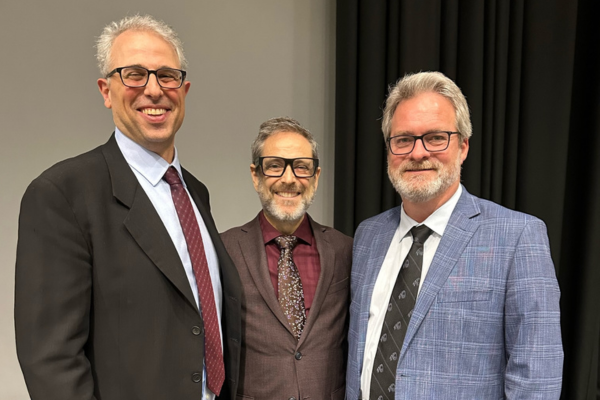
This year’s lecture was delivered by Max Kelz, MD, PhD, the Lee A. Fleisher Professor and Vice Chair of Research in the Department of Anesthesiology and Critical Care at the University of Pennsylvania. Titled “To be anesthetized, perchance to sleep. Ay, there’s the rub,” Kelz’s presentation challenged long-held assumptions about how anesthesia works and offered a fresh perspective on the science of consciousness.
Drawing from the intersection of systems neuroscience, consciousness research, and the study of sleep and hibernation, Kelz explored how the brain transitions into and out of anesthetized states. His work has helped redefine a fundamental concept in anesthesiology: that losing consciousness and regaining it are not simply reverse processes. Instead, these transitions involve distinct neural pathways and mechanisms—a discovery that has significantly advanced clinical understanding of anesthesia.
“Dr. Kelz’s fascinating insights into the distinct neural mechanisms of entering and exiting anesthesia challenge the very core of how we understand consciousness,” said Michael S. Avidan, MBBCh, FCA SA, Dr. Seymour and Rose T. Brown Professor and head of the Department of Anesthesiology. “His pioneering work bridges systems neuroscience and clinical practice, inspiring our department to continue pushing the boundaries of discovery.”
Before the lecture, attendees gathered for the department’s annual Academic Showcase, which featured more than 70 poster presentations representing the work of faculty, clinicians, researchers, trainees, and staff. By showcasing projects that spanned basic and clinical research, educational innovation, and quality improvement, the event highlighted the wide-ranging efforts underway to enhance patient care.
“The breadth of work was remarkable,” said Rachel Moquin, EdD, Vice Chair for Academic Affairs and Professional Development. “The Academic Showcase truly reflects our department’s culture of collaboration, team science, and mutual support.”
Together, the Academic Showcase and C.R. Stephen Lecture served as more than academic traditions, as they fostered connection across the department and highlighted a shared commitment to discovery, teamwork, and excellence in anesthesiology.


