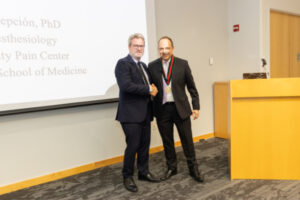
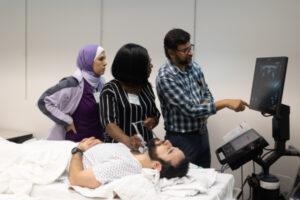
We’re delighted to announce the 2023 residency and outstanding teacher award recipients!
2023 Residency & Outstanding Teacher Award recipients announced
Department of
We’re delighted to announce the 2023 residency and outstanding teacher award recipients!
Brandon Tan, MD, was recently awarded Mentored Research Training Grant from the Foundation for Anesthesia Education and Research (FAER) to support his research on lipid modulation of the serotonin 3 receptor.
Richard Benzinger, MD, PhD, will serve as Interim Vice Chair for Education for the Department of Anesthesiology, effective May 15, 2023.
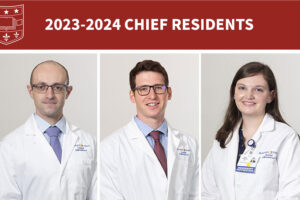
We are excited and proud to announce the Chief Residents for the 2023-24 academic year: Avi Dobrusin, MD, Samuel Erlinger, MD, and Mallory Hawksworth, MD.
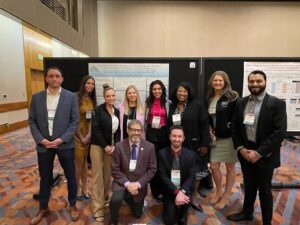
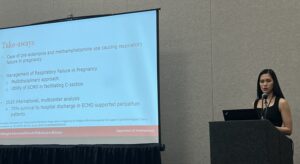
Members of the Department of Anesthesiology at Washington University School of Medicine in St. Louis recently attended and participated in the International Anesthesia Research Society (IARS) Annual Meeting in Denver, CO, on April 14-16. Three residents, four physicians, and one principal investigator presented on various topics throughout the weekend.
Members from the Department of Anesthesiology at Washington University School of Medicine in St. Louis attended and participated in the Midwest Anesthesia Residents’ Conference (MARC) Annual Meeting on April 14-16 in Milwaukee, WI. WashU had two fourth-year residents, Lauren Lagrimas, MD, and Dima Aladdin, MD, present cases in the competition.
Dr. Danish Jaffer has been selected as the program director of the Obstetric Anesthesiology Fellowship Program.
On March 17, 2023, the Department of Anesthesiology matched with 22 physicians who will begin their anesthesiology internship at WashU this summer.
Washington University School of Medicine in St. Louis announced that it will no longer submit data to U.S. News & World Report to support their “best medical schools” survey and ranking.
Brandon Tan, MD, PGY5 and an ASAP trainee, has been selected as one of the 2023 Dean’s Scholars. His project explores how the serotonin 3 receptor—implicated in nausea, depression, anxiety, and psychosis—changes its activity when the lipid environment is altered.