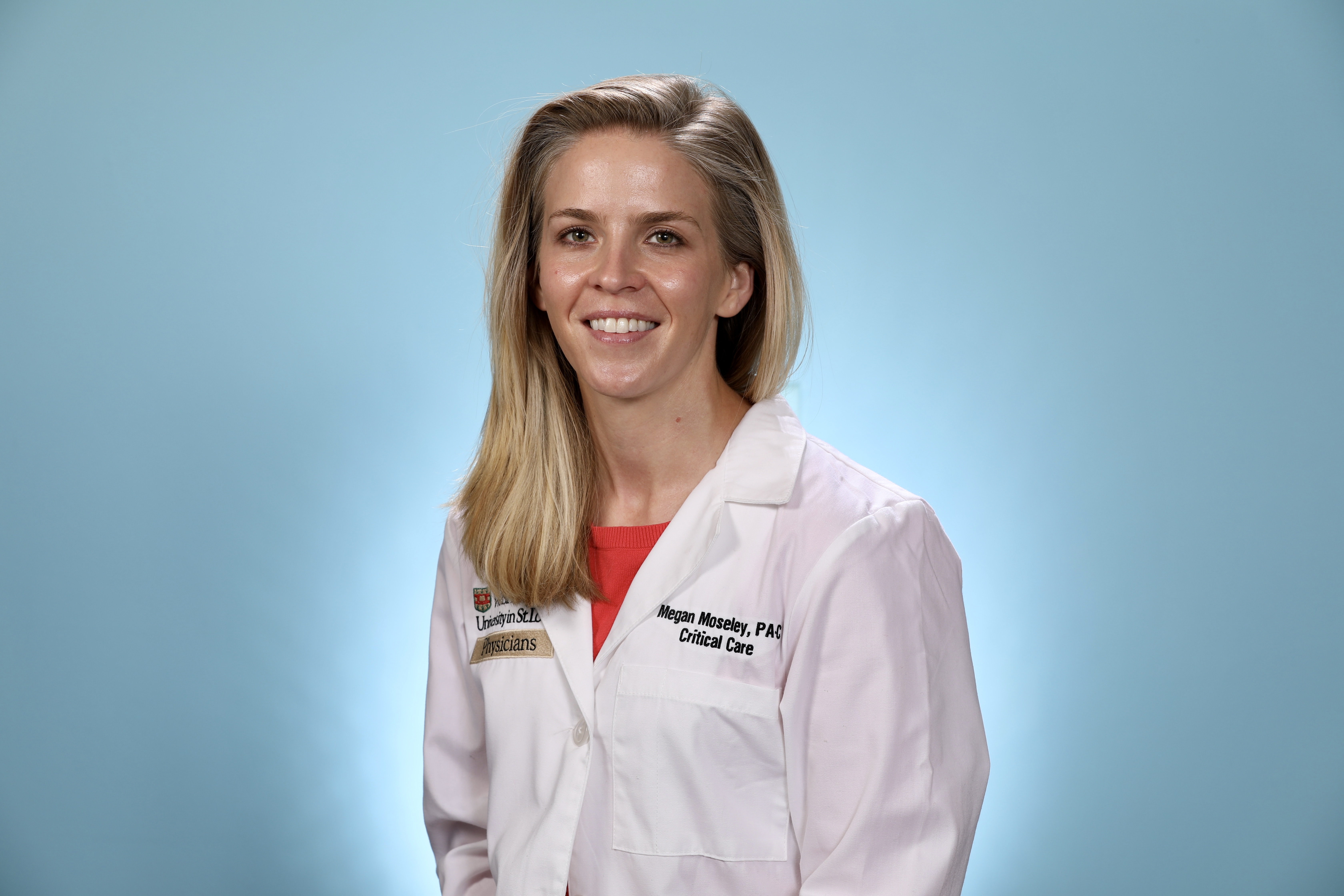
Megan Moseley, PA-C, has been selected as one of only three people nationwide to receive the 2025–26 AAPA-PAEA Research Fellowship. She is the first physician assistant (PA) from WashU Medicine to earn this honor since the fellowship’s inception.
The highly competitive program, offered jointly by the American Academy of PAs (AAPA) and the Physician Assistant Education Association (PAEA), provides fellows with protected research time, mentorship, and resources to strengthen their skills as clinical researchers.
Moseley’s project will focus on developing and implementing a structured, competency-based point-of-care ultrasound (POCUS) curriculum for Advanced Practice Providers (APPs) in critical care, a group that includes physician assistants and nurse practitioners. Although POCUS is widely recognized as a critical diagnostic tool among physicians, its integration into APP practice remains inconsistent due to limited access to structured training, credentialing pathways, and institutional support.
“POCUS has the potential to significantly enhance the timeliness and accuracy of bedside diagnosis in critical care,” said Moseley. “Yet many APPs do not have access to formal, affordable training programs. Through this fellowship, my goal is to create a sustainable curriculum that equips APPs with the skills and confidence to integrate POCUS into routine clinical practice
Moseley will be mentored throughout the fellowship by Enyo Ablordeppey, MD, MPH, associate professor and associate vice chair for engagement and culture.
“Megan’s project addresses a critical gap in APP education and practice,” said Ablordeppey. “By creating a structured training pathway, she is not only helping elevate the role of APPs at our institution but also setting the stage for national adoption of POCUS training models. This fellowship is a recognition of her vision and commitment to advancing the profession.”
Over the next year, Moseley will complete her research project, engage in fellowship seminars, and present her findings at national conferences. By the end of the program, she plans to publish her results and develop a toolkit for scaling the curriculum to other institutions.
“This fellowship is about more than my own research—it’s about building a foundation for future PA researchers and educators,” Moseley said. “I’m grateful for the support of WashU and Dr. Ablordeppey, and I hope this work will ultimately improve patient care and broaden the scope of practice for APPs nationwide.”